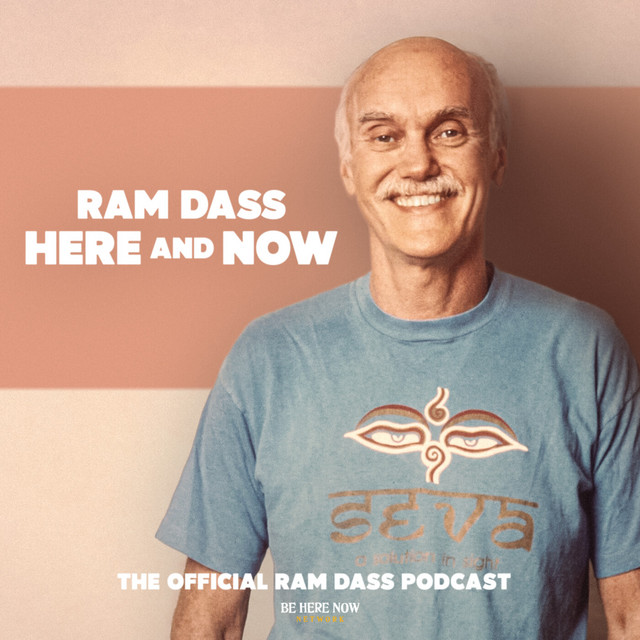
In this brief reflection, Ram Dass describes the experience of being in Maharaji's presence as a state of being "bathed" in love and divine grace. Rather than a teaching conveyed through words, Maharaji's spiritual power operates through direct transmission—a non-verbal communication of presence itself. This speaks to a core spiritual principle: that the deepest teachings are often not spoken but received, and that proximity to a realized teacher can itself become a path of transformation.
What Does It Mean to Be "Bathed in Presence"?
Ram Dass's phrase "bathed in presence" suggests something far more tangible than metaphor. To be bathed implies immersion—not standing at a distance, but surrounded, soaked in, unable to escape the quality of consciousness radiating from another being. In this case, that being is Maharaji, Ram Dass's guru, whom he encountered in India in the late 1960s and whose influence shaped the trajectory of his entire spiritual path.
When Ram Dass speaks of Maharaji's presence, he is pointing to a dimension of spiritual life that cannot be easily reduced to doctrine or philosophy. Presence is not an idea to be understood intellectually but a condition to be experienced. It is the felt sense of being in the company of someone whose consciousness has undergone fundamental transformation—someone awake, in Hindu and Buddhist terms, to the nature of reality itself.
This quality of presence is not manufactured or performed. It arises naturally from a mind that has released its habitual patterns of contraction, fear, and self-referential thinking. When such a presence is encountered, it can act like a mirror, reflecting back to the observer their own capacities for presence, love, and clarity. The bathing metaphor captures this mirroring effect—you don't have to work to absorb the presence; it surrounds you and penetrates you simply by virtue of proximity.
How Does Spiritual Transmission Work Beyond Words?
A central thread in Ram Dass's teaching is the concept of spiritual transmission—the idea that the deepest realizations and capacities are transmitted not through language but through direct contact with consciousness itself. This is sometimes called "transmission" or "darshan" in Hindu and Buddhist traditions, where even sitting in the presence of a realized teacher without formal teaching can constitute a complete spiritual practice.
Maharaji embodied this principle. Ram Dass's teachings consistently return to the fact that Maharaji rarely explained anything in conventional pedagogical ways. Instead, Maharaji worked through spontaneous, often paradoxical acts—sudden harshness followed by overwhelming tenderness, miracles attributed to him, and above all, the palpable reality of his presence. Those who spent time with him report being fundamentally altered not by what he said but by what he was.
This challenges the modern assumption that spiritual growth is primarily a matter of acquiring correct information or learning the right techniques. In the transmission model, transformation occurs through alignment with a more developed consciousness. The presence of a realized being can quiet the discursive mind, slow the constant narrative running through awareness, and create space for a different order of knowing to emerge. You don't think your way into enlightenment; you soak in it.
What Is the Relationship Between Love and Presence?
Ram Dass consistently connects Maharaji's presence with love—not romantic love or even personal affection, but what Sanskrit traditions call "prema" or divine love. This is love without object, love as a fundamental property of enlightened consciousness itself. A being bathed in such presence receives the direct knowing that they are loved, not for what they do or who they are, but simply because consciousness itself is fundamentally loving.
This distinction matters. Most human experience of love is conditional and transactional: you love because someone is beautiful, kind, useful, or mirrors something you need. Divine love, as manifested through a teacher's presence, asks nothing and demands nothing. It simply is, available to anyone who comes near, regardless of their merit or readiness. This unconditional quality is what makes it "grace"—it cannot be earned, only received.
For Ram Dass, being bathed in this presence became the central organizing principle of his spiritual life. It was not a fleeting emotional experience but a recognition of what the deepest layer of reality actually is: love, consciousness, the fundamental nature of awareness itself. Maharaji's presence simply reflected this back into ordinary human perception so that it could no longer be denied or ignored.
Why Does Presence Matter More Than Teaching?
In contemporary spiritual culture, there is often an overemphasis on teachings, techniques, and intellectual understanding. Yet Ram Dass points to something older and more direct: the power of being in contact with a consciousness that has actually completed the journey. This is not anti-intellectual, but it does prioritize a different order of knowledge.
A teaching can be received, analyzed, debated, and set aside. Presence, by contrast, works on the nervous system, the emotional body, and the deep structures of identity itself. It operates below the level of the thinking mind. Someone bathed in Maharaji's presence might find their own defensive patterns beginning to dissolve without knowing why. They might experience spontaneous compassion, a sense of being held, or a recognition that the separation they had always assumed between themselves and others was illusory.
This is not to say that teachings have no value, but rather that teachings are most powerful when transmitted by someone whose presence embodies what the teachings describe. When a teacher speaks of non-dual awareness—the recognition that all separation is ultimately illusory—and that teacher's very presence radiates that non-duality, something shifts in the listener that no amount of theoretical explanation could produce.
What Can We Learn From This Brief Reflection?
Though this is a brief excerpt, Ram Dass is gesturing toward several essential truths about the spiritual path. First, that proximity to consciousness matters—not in a magical sense, but in a real and measurable sense. The nervous systems of two people in conversation begin to synchronize; the coherence of one brain affects another. A being who has stabilized in higher states of consciousness literally broadcasts those states.
Second, that there is a difference between knowing about enlightenment and being in its presence. All the philosophy in the world cannot substitute for the direct encounter. This is why spiritual traditions have always valued the relationship between student and teacher—not as authority figure and subordinate, but as one consciousness pointing toward the awakening available to another.
Finally, Ram Dass reminds us that the deepest spiritual gift is to be loved unconditionally, and to have that unconditional love reflected back to us so powerfully that we cannot deny it. In Maharaji's presence, seekers found themselves bathed not in ideology but in grace—in the direct knowing of their own nature as inseparable from the nature of love itself.
Where to Go From Here
If you are drawn to the concept of transmission and the power of a realized teacher's presence, the full conversation referenced in the description offers more extensive exploration of Ram Dass's relationship with Maharaji. Ram Dass's book "Be Here Now" and his extensive recorded teachings also return repeatedly to the theme of how presence—one's own and that of teachers—becomes the vehicle for spiritual awakening.
You might also explore the practices that Ram Dass recommends for cultivating presence in your own life: meditation, kirtan (devotional singing), and conscious service. These are not substitutes for the grace of transmission, but they do align your own consciousness with the principle Ram Dass is describing, making you more available to the presence wherever you encounter it.